
Best IT Certifications for Network Engineers in 2026
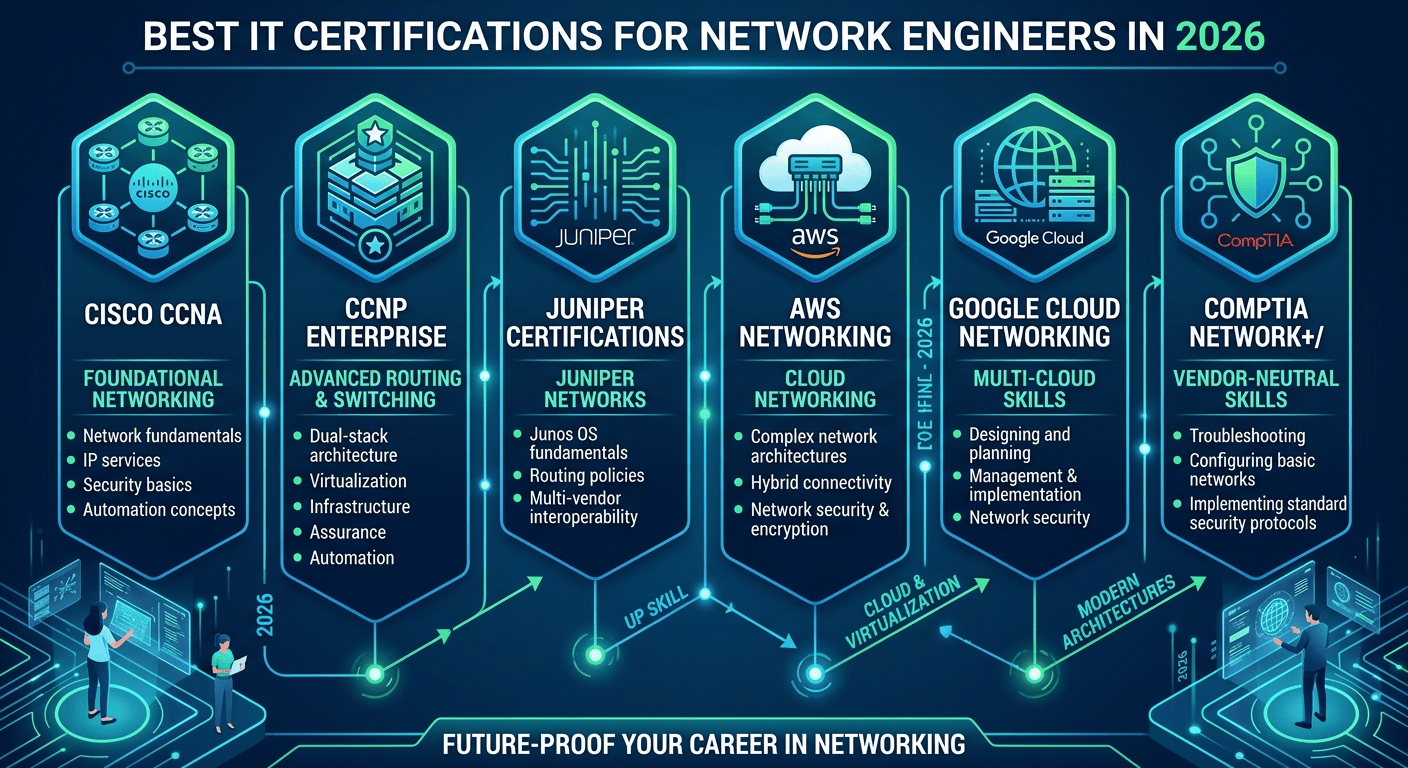
Network engineering continues to evolve as organizations adopt hybrid cloud environments, automation, and increasingly complex security requirements. For professionals in this field, certifications remain one of the clearest ways to validate skills and stand out in a competitive job market.
Choosing the right certification path in 2026 depends on your experience level, career goals, and the technologies your target employers use. This guide breaks down the best IT certifications for network engineers, from foundational credentials to advanced specializations.
Why Certifications Matter for Network Engineers
Network engineering roles require both theoretical knowledge and practical, hands-on skills. Certifications help bridge that gap by validating specific competencies employers look for, such as configuring routers, securing networks, and managing cloud connectivity.
In a field where technology changes quickly, certifications also demonstrate that a professional stays current with evolving standards and best practices.
Key Certification Categories for Network Engineers
Before diving into specific certifications, it helps to understand the general categories available:
- Foundational certifications – Introduce core networking concepts for beginners
- Vendor-specific certifications – Focus on platforms like Cisco, Juniper, or specific cloud providers
- Security-focused certifications – Validate network security and defense skills
- Cloud networking certifications – Address hybrid and multi-cloud connectivity skills
- Advanced/expert certifications – Target senior engineers designing complex network architectures
Best Foundational Certifications
CompTIA Network+
CompTIA Network+ remains a strong starting point for aspiring network engineers. It covers essential networking concepts, including infrastructure, operations, and troubleshooting, without tying candidates to a specific vendor’s technology.
Best for: Entry-level professionals building foundational networking knowledge.
Cisco Certified Support Technician (CCST) Networking
This entry-level Cisco certification introduces basic networking concepts and terminology, making it a practical first step for those planning to pursue more advanced Cisco credentials later.
Best for: Beginners interested specifically in the Cisco ecosystem.
Best Intermediate Certifications
Cisco Certified Network Associate (CCNA)
CCNA remains one of the most respected certifications for network engineers. It covers networking fundamentals, IP connectivity, security fundamentals, and automation basics.
Best for: Engineers ready to move beyond foundational concepts into practical, job-ready skills.
Juniper Networks Certified Associate (JNCIA)
For professionals working with Juniper equipment, JNCIA validates foundational knowledge of Junos OS and networking fundamentals within the Juniper ecosystem.
Best for: Engineers in environments that rely on Juniper infrastructure.
Best Advanced and Specialized Certifications
Cisco Certified Network Professional (CCNP Enterprise)
CCNP Enterprise builds on CCNA knowledge with deeper expertise in enterprise networking, including advanced routing, wireless, and automation topics.
Best for: Mid-career engineers managing complex enterprise networks.
Certified Information Systems Security Professional (CISSP)
While broader than networking alone, CISSP is valuable for network engineers moving toward security-focused roles, covering risk management, architecture, and security operations.
Best for: Engineers transitioning into network security leadership roles.
Cloud Networking Certifications
As organizations shift workloads to the cloud, certifications focused on cloud networking—covering virtual networks, load balancing, and hybrid connectivity—have become increasingly valuable.
Best for: Engineers supporting hybrid or multi-cloud infrastructure.
Key Features and Benefits of These Certifications
Across these certification options, candidates typically gain:
- Validated expertise in core and advanced networking concepts
- Hands-on skills applicable to real-world network configurations
- Recognition from employers seeking verified technical competence
- A structured learning path for career progression
- Exposure to current industry standards and best practices
Advantages and Practical Value
Certifications offer more than resume value. They provide structured learning paths that help engineers build skills systematically rather than through scattered, unguided study. This is especially valuable in networking, where concepts build on each other progressively.
For many professionals, certifications also open doors to higher-paying roles and specialized positions, such as network security engineer or cloud network architect, that require verified expertise.
Challenges and Limitations to Consider
Pursuing networking certifications isn’t without challenges:
- Vendor-specific certifications may limit flexibility if you switch technology stacks
- Advanced certifications often require significant hands-on experience beforehand
- Certification costs and renewal requirements can add up over a career
- Rapidly evolving technology means some content can become outdated between exam updates
Understanding these limitations helps you choose certifications that align with long-term career goals rather than short-term gains.
Comparison Table: Popular Network Engineering Certifications
| Certification | Level | Focus Area | Best For |
| CompTIA Network+ | Foundational | Vendor-neutral networking basics | Beginners |
| CCNA | Intermediate | Cisco networking fundamentals | Early-career engineers |
| JNCIA | Intermediate | Juniper networking fundamentals | Juniper-focused environments |
| CCNP Enterprise | Advanced | Enterprise routing and automation | Mid-career engineers |
| CISSP | Advanced | Security architecture and management | Security-focused roles |
This comparison helps illustrate how certifications align with different experience levels and career directions.
How to Choose the Right Certification Path
- Assess your current experience level to determine whether foundational or intermediate certifications fit best.
- Identify your target technology stack, such as Cisco, Juniper, or a specific cloud provider.
- Research job postings in your target roles to see which certifications employers frequently request.
- Set a realistic timeline based on your current workload and study availability.
- Gain hands-on practice through labs or trial environments alongside your studies.
- Plan a progression path, moving from foundational to advanced certifications over time.
- Track renewal requirements to keep certifications active as technology evolves.
Practical Tips and Best Practices
- Combine certification study with real-world lab practice whenever possible
- Focus on understanding concepts, not just memorizing exam answers
- Join professional networking communities to learn from experienced engineers
- Use practice exams to identify weak areas before scheduling official tests
Improve your network certification exam readiness with focused practice questions and study resources: https://certempire.com
Conclusion
The best IT certifications for network engineers in 2026 depend heavily on individual career goals, whether that’s building foundational skills, specializing in a vendor ecosystem, or moving into security and cloud networking roles. By choosing a certification path that aligns with your experience and target roles, and pairing it with hands-on practice, you can build a credential portfolio that genuinely reflects your networking expertise.
FAQs
Which certification should a beginner network engineer start with?
CompTIA Network+ is generally recommended as a first step, since it covers vendor-neutral networking fundamentals applicable across many career paths.
Is CCNA still relevant in 2026?
Yes. CCNA remains widely recognized and continues to validate essential networking skills employers actively look for.
Do network engineers need security certifications?
While not mandatory, security certifications like CISSP are increasingly valuable as network security becomes a larger part of engineering roles.
How long does it take to prepare for CCNA?
Preparation time varies, but many candidates spend two to four months studying, depending on prior networking experience.
Are vendor-specific certifications worth it if I might switch technologies later?
They still hold value by demonstrating deep technical skills, though pairing them with vendor-neutral certifications can offer more flexibility long-term.
Read More: Are Azure Certifications Worth It in 2026? Skills, Jobs, and Career Value